Notes on the Neijing · Jing · Qi · Shen · 精气神
Jing, Qi & Shen Explained: Everyday Vitality
What does Jing Qi Shen mean? Explore Jing as foundation, Qi as driving force and Shen as spirit in traditional Chinese culture, then connect the ideas with ordinary rest, movement and a settled mind.
English narration with English subtitles · 1 min 29 sec.
This video is available as a phone edition. Read this page here, or open it on your phone to watch.
AI-illustrated film with fictional cartoon adults, English narration and on-screen subtitles. The traditional theory, classical passages and present-day applications are identified in the lesson.
From a familiar phrase to three connected ideas.
Foundation, force and spirit
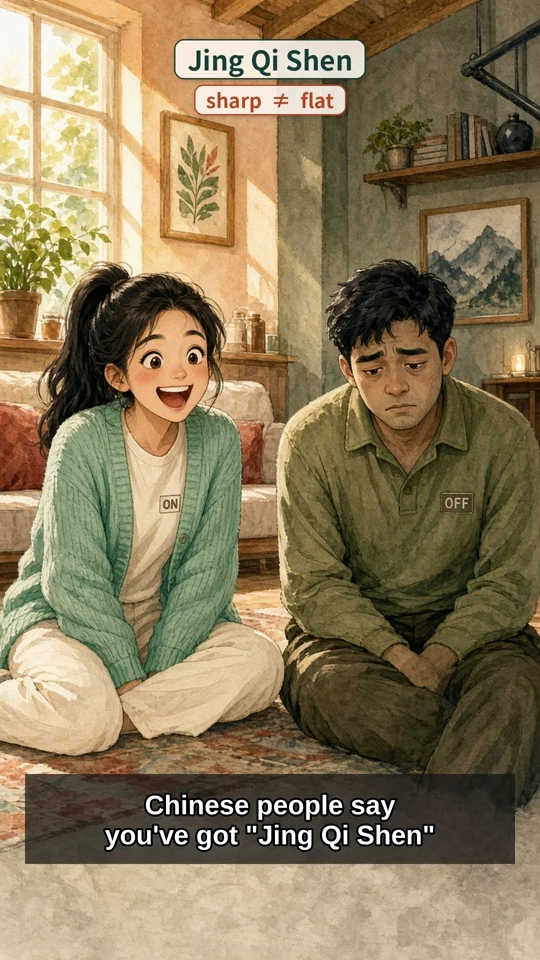
The film uses a simple contrast: people in the same room can appear alert or flat. Its explanation introduces Jing, Qi and Shen as connected aspects of a traditional account of vitality, rather than labels that rank people.
Bring the idea into an ordinary day
The film points to room for sleep and rest, gentle movement and rhythmic breathing, and a pause from circling thoughts. Choose a manageable routine; this introductory framework is not a formula or a diagnosis.
This film presents a traditional teaching synthesis, rather than a verbatim reading of one Neijing passage. Jing, Qi and Shen are traditional concepts; the film’s root, force and light metaphor and its transformation arrows are teaching images, not measured biochemical pathways. Kidney refers to the traditional functional framework, not simply the anatomical organ. Suwen Chapter 1 provides the context of measured habits and guarding essence and spirit. The quoted passage below is additional reading context, not a quotation spoken in the film.
食饮有节,起居有常,不妄作劳。
Editorial translation: Eat and drink with measure, keep regular daily habits, and avoid reckless exertion.
Read the Chinese source · Suwen · Chapter 1 · 上古天真论 →Educational only—not a diagnosis or prescription. The terms describe a traditional framework; they do not diagnose the cause of tiredness or promise a treatment outcome.
Read the full English transcript
What does Jing Qi Shen mean?
Chinese people say you've got "Jing Qi Shen" when you're sharp—and "no Jing Qi Shen" when you're flat. What do those three words mean— and how do you care for them?
A traditional teaching map
Educational map: Jing, Qi, and Shen are three sides of one vitality— not a prescription, not scare talk.
Jing: foundation
Jing is the material foundation, stored in the kidneys. Some comes from your parents; some from food and rest. It backs growth, reproduction, and reserves. When Jing is solid, the root is firm.
Qi: driving force
Qi is the energy and power. Jing turns into Qi. Qi moves blood, warms you, and helps you stay defended. When Qi is enough, you feel driven—not empty.
Shen: spirit
Shen is the spirit in charge—thinking, mood, sleep— fed by blood and Qi. When Shen is steady, your mind is clear and nights settle.
One connected framework
Jing turns into Qi; Qi turns into Shen. Jing is the root, Qi the force, Shen the light. Three faces of one body—miss one, and it wobbles.
Everyday care
Everyday care, not a formula. Nourish Jing: sleep enough, don't burn nights, keep desire moderate. Nourish Qi: breathe with rhythm and move. Nourish Shen: quiet the mind; stop spinning every thought.
Continue learning
Come learn the fuller Neijing map at yineijing.com. Educational only—not a diagnosis or a prescription.
中文要点 · Chinese summary
日常所说的“精气神”,可以作为理解传统生命观的一扇门。本片以“根、力、光”说明精、气、神的关系:精是根基与储备,气是动力,神涉及精神意识与情志。影片再落到睡眠休息、呼吸活动与安定心神等生活方向。这是传统概念的教学介绍,不是诊断、处方或效果保证。