A note from Jackie · Five Phases · 五行
Five Phases: Seeing the Body as a Whole
Jackie explains the Five Phases and Five Zang, the generating and restraining cycles, and how this traditional whole-body perspective can guide meals, sleep, measured activity and emotional care.
English narration with English subtitles · 1 min 46 sec.
Download Jackie’s lesson.
Watch offline or share with a friend. Please retain the Notes on the Neijing credit and yineijing.com ending.
Both editions include English subtitles.
Jackie directs this project. This video uses an AI-created presenter based on his photographs and synthetic English narration. The traditional theory, classical passages and present-day applications are identified in the lesson.
Read the illustrated lesson.
Five Phases and Five Zang
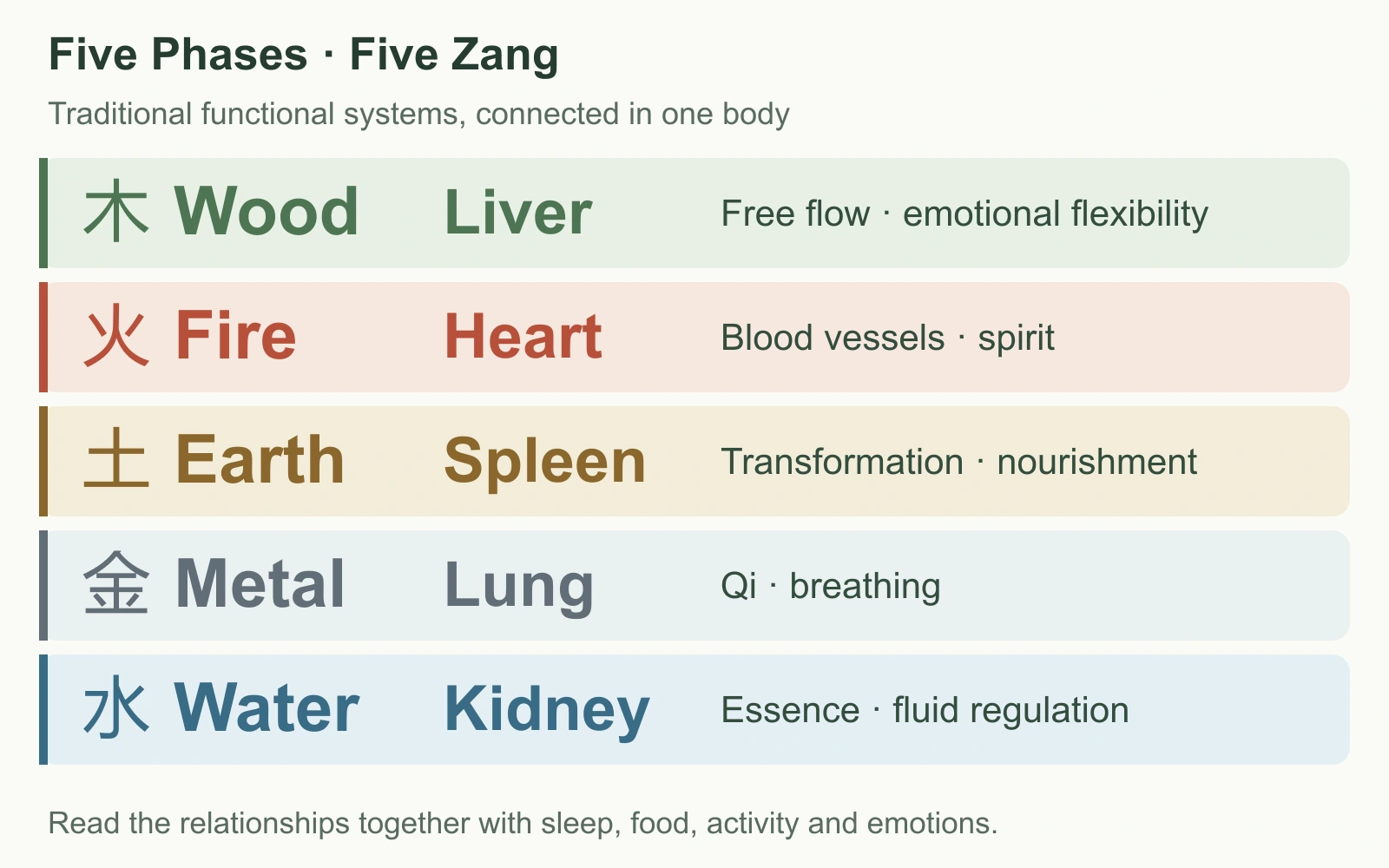
Wood–Liver concerns free flow; Fire–Heart concerns blood vessels and spirit; Earth–Spleen concerns transformation and nourishment; Metal–Lung concerns qi and breathing; Water–Kidney concerns essence and fluid regulation. Read these traditional roles together with a person’s meals, rest, activity and emotional life.
Generating: support and nourishment
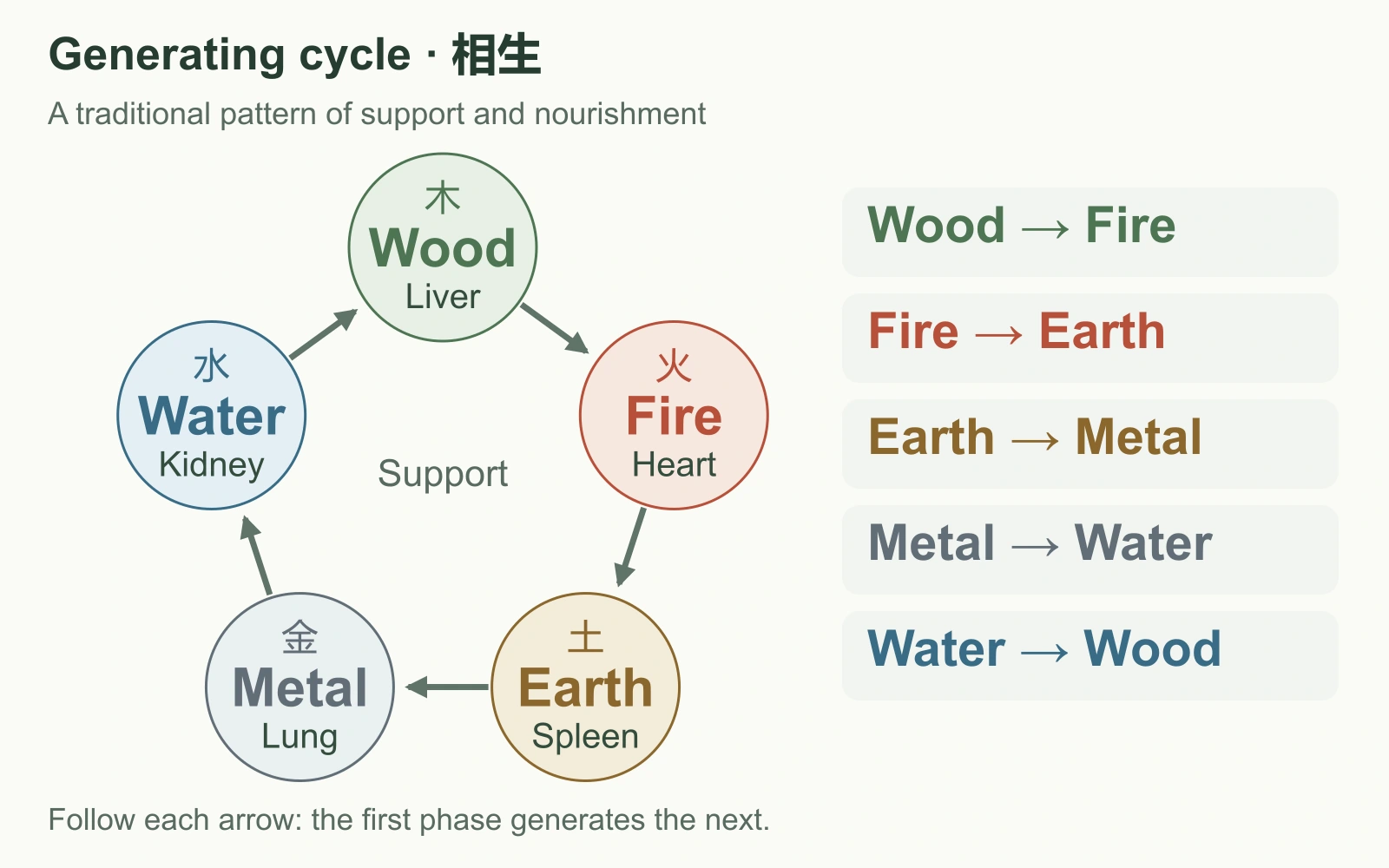
Wood generates Fire; Fire generates Earth; Earth generates Metal; Metal generates Water; Water generates Wood. The cycle expresses a traditional relationship of support. Keep the phase names and traditional zang correspondences together when learning the pattern.
Restraining: proportion and coordination
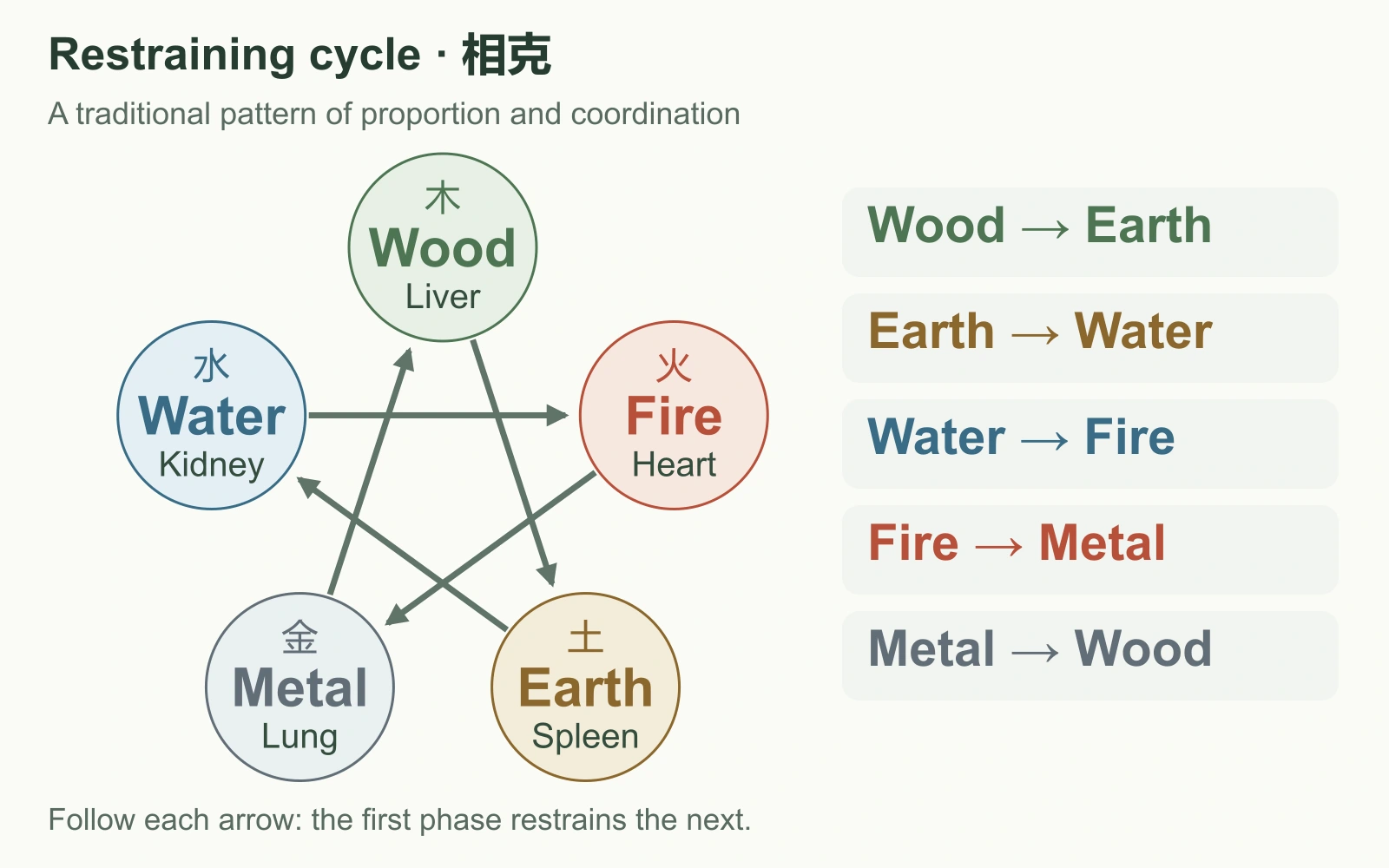
Wood restrains Earth; Earth restrains Water; Water restrains Fire; Fire restrains Metal; Metal restrains Wood. Normal restraint gives the traditional framework its sense of proportion: support and coordination work together.
Seasons add a changing care emphasis
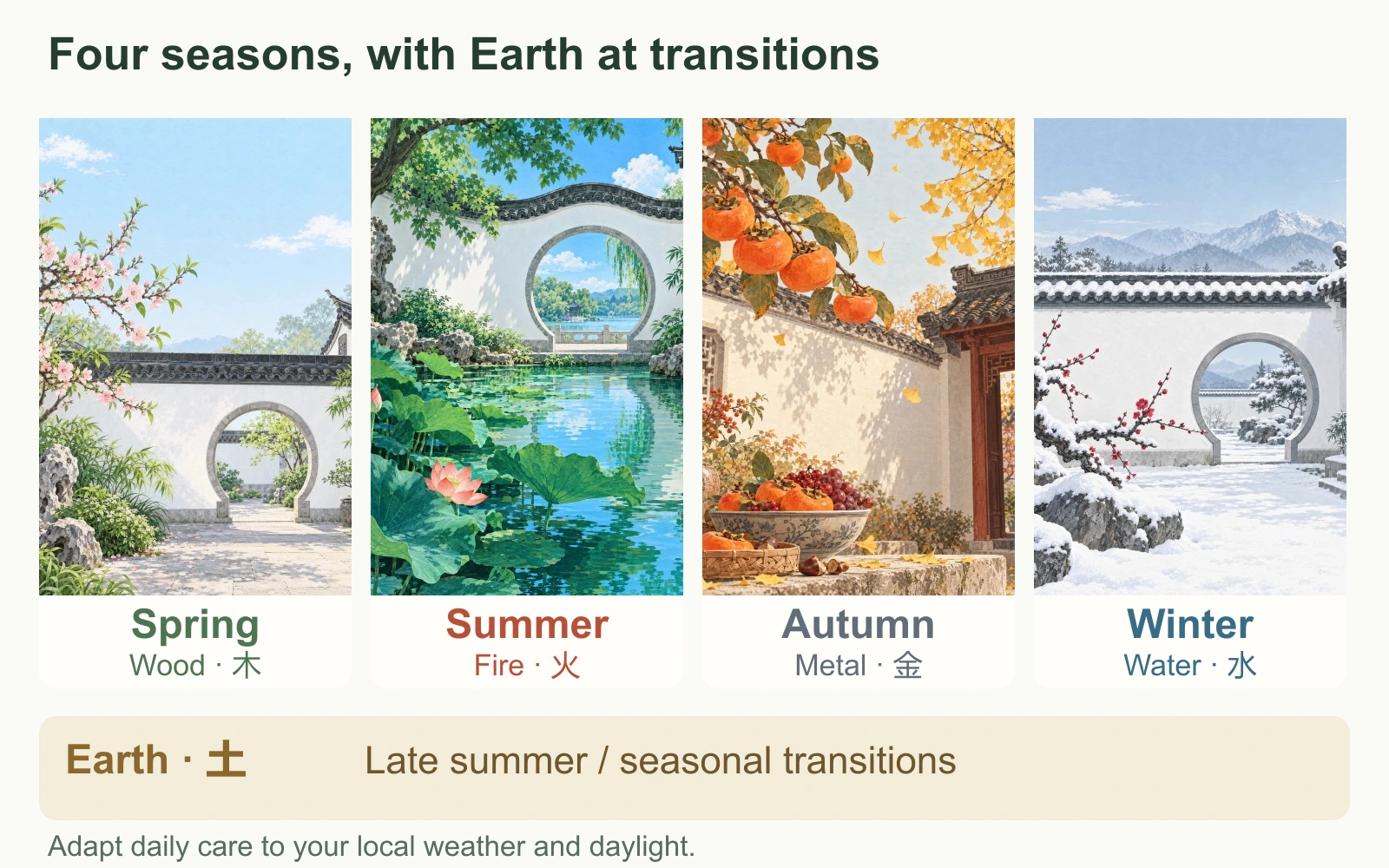
Spring emergence, summer flourishing, autumn gathering and winter conserving give daily care changing priorities. Earth is linked with late summer or seasonal transitions in different traditional accounts. Apply these ideas through the actual weather, daylight, workload and daily needs where you live.
Bring the whole pattern into daily life
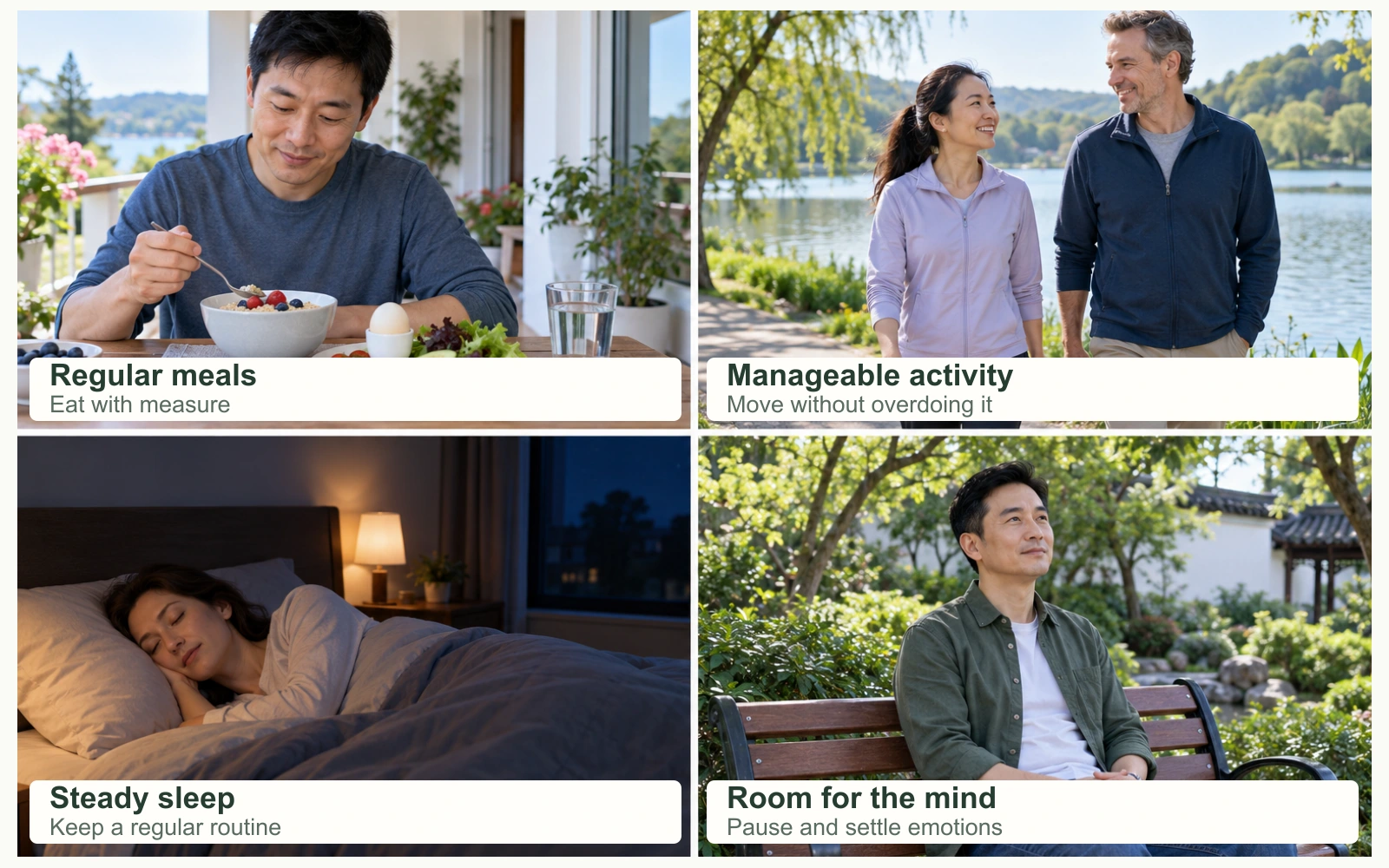
If a demanding week brings rushed meals, late nights, little movement and a tense mind together, start with that whole pattern. Make one meal more regular, protect a workable sleep opportunity, choose manageable activity or create a quieter transition. Review what helps, then keep the change that you can repeat.
Suwen Chapter 5 (Yin Yang Ying Xiang Da Lun) supplies the phase–zang correspondences; Chapter 8 (Ling Lan Mi Dian Lun) describes traditional functional roles. Chapter 29 (Tai Yin Yang Ming Lun) discusses Spleen–Earth across seasonal transitions. Chapter 2 supplies four-season care, and Chapter 1 supplies measured food, regular living and effort. The cycle diagrams follow standard traditional terminology. The everyday examples are our editorial applications.
食饮有节,起居有常,不妄作劳。
Editorial translation: eat and drink with measure, keep regular daily habits, and avoid reckless exertion.
Read the full English transcript
See the body as a whole.
Hi, I'm Jackie. The Five Phases offer a traditional way to see relationships across the body, nature, and daily life. Wood, Fire, Earth, Metal, and Water describe patterns of change.
Five phases. Five zang.
In Chinese medicine, Wood corresponds to Liver, Fire to Heart, Earth to Spleen, Metal to Lung, and Water to Kidney. These names describe traditional functional systems, connecting movement, nourishment, breathing, emotions, and stored essence.
How the phases support.
The generating cycle describes support: Wood generates Fire, Fire generates Earth, Earth generates Metal, Metal generates Water, and Water generates Wood. The circle helps us remember that each phase participates in a connected pattern.
How the phases restrain.
The restraining cycle adds coordination: Wood restrains Earth, Earth restrains Water, Water restrains Fire, Fire restrains Metal, and Metal restrains Wood. In this framework, restraint means keeping an activity in proportion, alongside support.
Let the season guide care.
The seasonal map links Wood with spring, Fire with summer, Metal with autumn, and Water with winter. Earth is often linked with late summer or seasonal transitions. Apply the rhythm to the weather and daylight where you live.
Bring the idea into your day.
Consider a busy week: late nights, rushed meals, little movement, and a tense mind. Look at that whole pattern. Begin with regular meals, a steadier sleep schedule, manageable activity, and a pause to settle your emotions. The Neijing puts it simply: eat with measure, live with regularity, and avoid reckless exertion. Choose one workable change today.
中文要点 · Chinese summary
五行是中医联系身体、自然与生活的传统思维框架:木肝、火心、土脾、金肺、水肾。这里的脏名包含传统功能体系。相生为木生火、火生土、土生金、金生水、水生木;相克为木克土、土克水、水克火、火克金、金克木。四时对应春木、夏火、秋金、冬水;土常与长夏或季节交替联系。日常应用重在将一组生活状态联系起来,落实食饮有节、起居有常、不妄作劳,并给情绪留出调节空间。先选一个做得到的调整。