A short foundations lesson · Yin–yang & Five Phases · 阴阳五行
Five Elements Explained: Yin–Yang & Patterns of Change
Five Elements, or Wu Xing, explained through Wood, Fire, Earth, Metal and Water: an illustrated lesson on yin–yang, support, boundaries and everyday balance.

English narration with English subtitles · 1 min 15 sec.
This video is available as a phone edition. Read this page here, or open it on your phone to watch.
Directed by Jackie Yuen. Owner-supplied cartoon illustrations and bilingual panel text accompany synthetic English narration. The traditional theory, classical passages and present-day applications are identified in the lesson.
Notice the pattern. Choose a useful response.
Five phases as a way of noticing change.
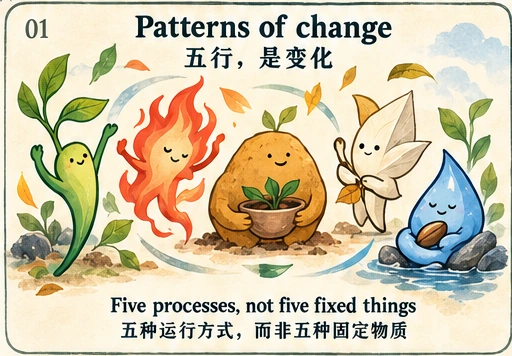
Begin with what is happening: something starts, becomes visible, becomes useful, is refined, or rests before another beginning. The five names offer a traditional organising framework for this lesson’s everyday examples.
The same phase can have different expressions.
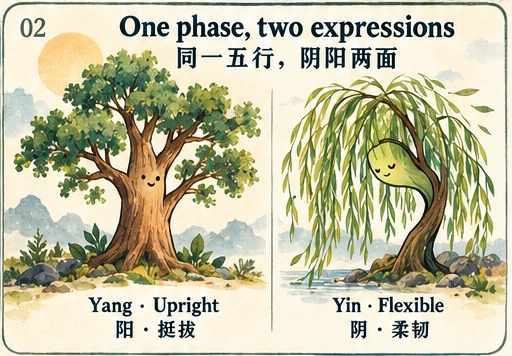
The upright tree and flexible willow show two ways of growing: direct and steady, or adaptable and responsive. Use the contrast to consider a situation and a response, rather than to give someone a fixed label.
Turn an idea into something workable.
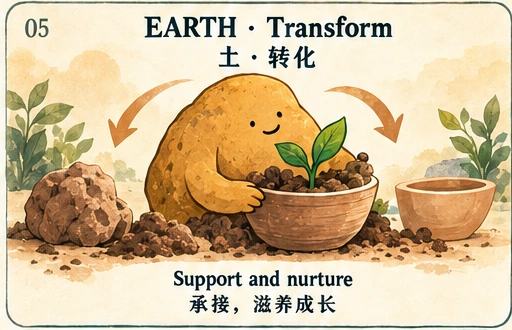
The Earth example asks what makes a routine useful. Gathered ideas need an ordinary structure: a repeatable action, suitable time or a manageable responsibility. This is the lesson’s modern analogy for transformation and nourishment.
Balance includes support and boundaries.
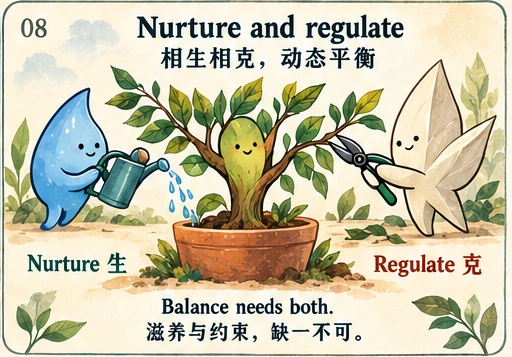
Watering and pruning give the final question a simple picture: what needs support, and what needs a boundary? The full generating and regulating cycles are explained in the linked Five Phases lesson and interactive map.
Suwen, Chapter 5 (Yin Yang Ying Xiang Da Lun), supplies the yin–yang foundation through 阴阳者,天地之道也. Shangshu, Hongfan, describes traditional phase properties through 水曰润下,火曰炎上,木曰曲直,金曰从革,土爰稼穑. The English translations are our editorial renderings. This lesson emphasises processes without claiming that early texts never referred to materials. Habits, projects, teamwork, the sturdy tree and flexible willow are modern teaching analogies, not classical quotations or fixed personality or health labels. The watering and pruning scene illustrates support and restraint; it does not draw every link in either cycle.
阴阳者,天地之道也
Editorial translation: Yin and yang are the pattern of Heaven and Earth.
Read the Chinese source · Suwen · Chapter 5 · 阴阳应象大论 →水曰润下,火曰炎上,木曰曲直,金曰从革,土爰稼穑
Editorial translation: Water moistens and descends; Fire blazes upward; Wood bends and straightens; Metal yields and changes; Earth receives sowing and harvest.
Read the Chinese source · Shangshu · Hongfan · 尚书·洪范 →Read the full English transcript
Patterns of change
Wood, Fire, Earth, Metal, Water: five patterns of change, not simply five objects. The point is how things move.
One phase, two expressions
Yin and yang come first. Even Wood has two expressions: upright and direct, like a sturdy tree; flexible and responsive, like a willow. Same growth, different approaches.
Wood · Begin and grow
Wood begins and reaches outward. Starting a habit or opening a project: that is the picture.
Fire · Express and flourish
Fire flourishes. An idea becomes visible. We speak, connect, and bring it to life.
Earth · Transform and nourish
Earth transforms and nourishes. Turn what you have gathered into something useful. Make a routine work.
Metal · Refine and focus
Metal refines. Trim what no longer helps. Fewer priorities, clearer focus.
Water · Rest and restore
Water stores and restores. Rest is not wasted time. It prepares the next beginning.
Balance needs both
Generating and regulating are not simple good and bad. Watering helps a plant grow; pruning keeps it balanced. In life, relationships or a team, ask: what needs support, and what needs a boundary?
中文要点 · Chinese summary
木、火、土、金、水,是五种变化的模式,不只是五种具体物质。重点在于它们怎样运行。 更根本的是阴阳。就算同样是木,也有两种表达:像大树一样挺拔直接,或像柳树一样柔韧、懂得顺势。同样是生长,走法可以不同。 木,是开始,是向外生长。养成一个习惯,或者启动一个项目,都可以用这个画面来理解。 火,是旺盛,是把想法表达出来。我们开口、与人连接,让一个想法真正活起来。 土,是转化,也是滋养。把已经积累的东西变成实际用处,让日常的事情运转起来。 金,是收敛,是整理。修掉不再有帮助的枝节,少一些头绪,重点就更清楚。 水,是潜藏,是休息和恢复。休息不是浪费时间,而是在为下一次开始蓄力。 相生相克,不是简单的好与坏。浇水帮助植物生长,修剪让它保持平衡。放到生活、人际关系或团队里,都可以问:哪里需要助推,哪里需要一点边界? 这些是理解变化和日常协作的教学比喻,不是用五行给一个人的健康、性格或命运下固定标签。