A short everyday-care lesson · Five seasons & emotional care · 五季与情志
Why Five Seasons? Chinese Medicine, Movement and Mood
An 86-second illustrated lesson on the five seasons in Chinese medicine, with a visual Five Phases map, an indoor-to-outdoor contrast and one everyday step for emotional care.
English narration with English subtitles · 1 min 26 sec.
This video is available as a phone edition. Read this page here, or open it on your phone to watch.
Owner-supplied illustrated film selected by Jackie Yuen. Watercolour illustrations depict fictional adults; the original English narration and burned-in captions are preserved. The traditional theory, classical passages and present-day applications are identified in the lesson.
Care for the body. Give feelings room.
See the five-season rhythm
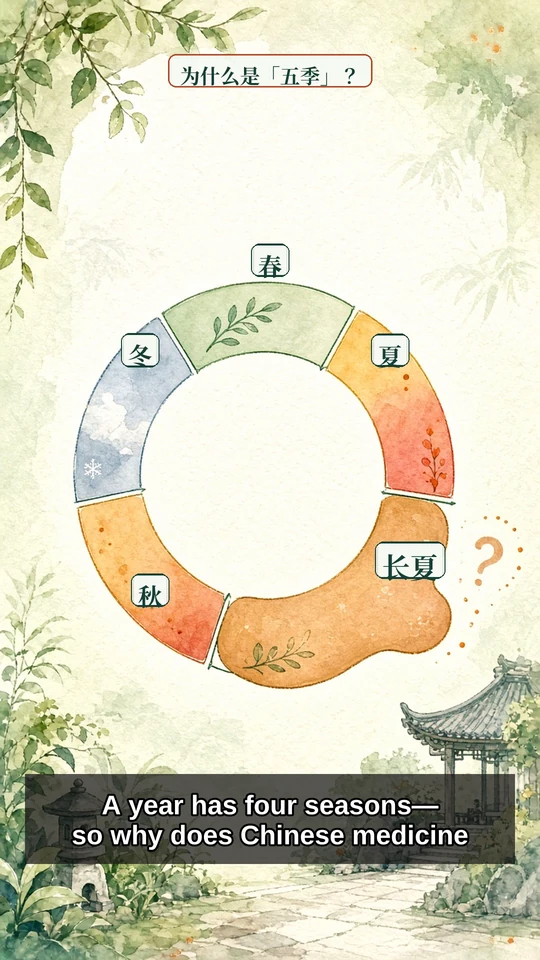
The ring makes the seasonal cycle visible. Spring, summer, late summer, autumn and winter form a traditional framework; it is not a new universal weather calendar.
Follow the Five Phases map
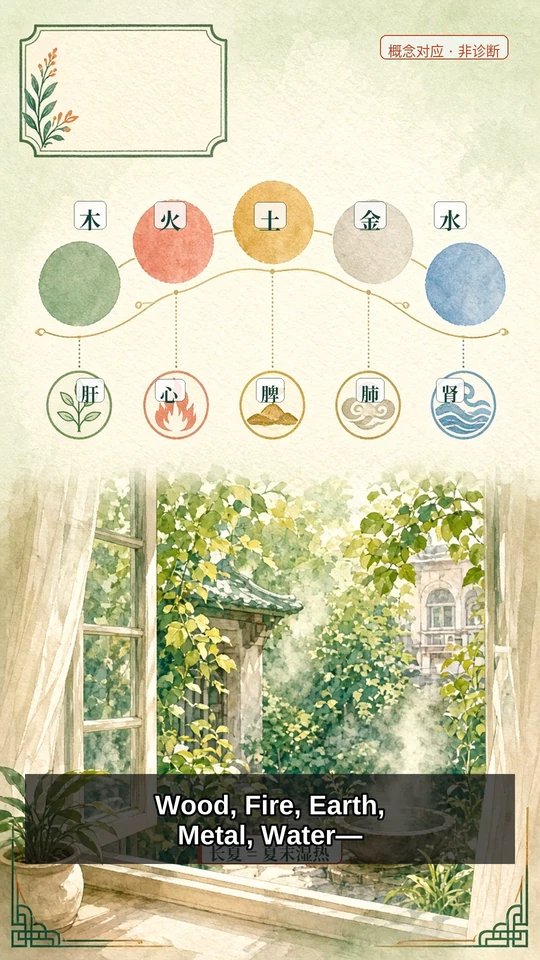
The map gives a traditional language for relationships between seasons and functional systems. It does not tell you that an organ is ill because of a particular feeling. Late summer has more than one traditional explanation; observe local heat, humidity and seasonal change rather than assuming fixed dates everywhere.
From being cooped up to stepping outdoors
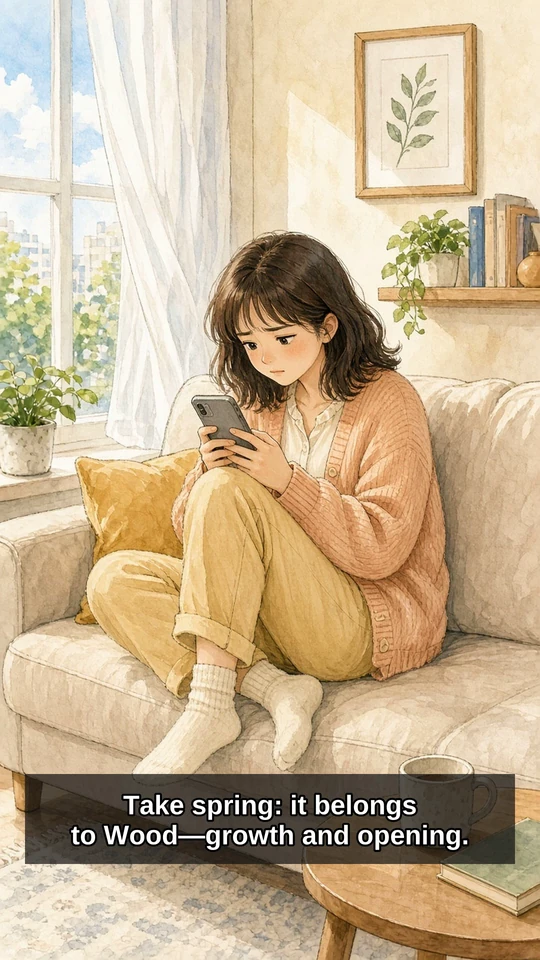
The closed posture and phone give the opening everyday state a visible form. Compare it with the same character moving comfortably in an open park.
Make room for comfortable movement
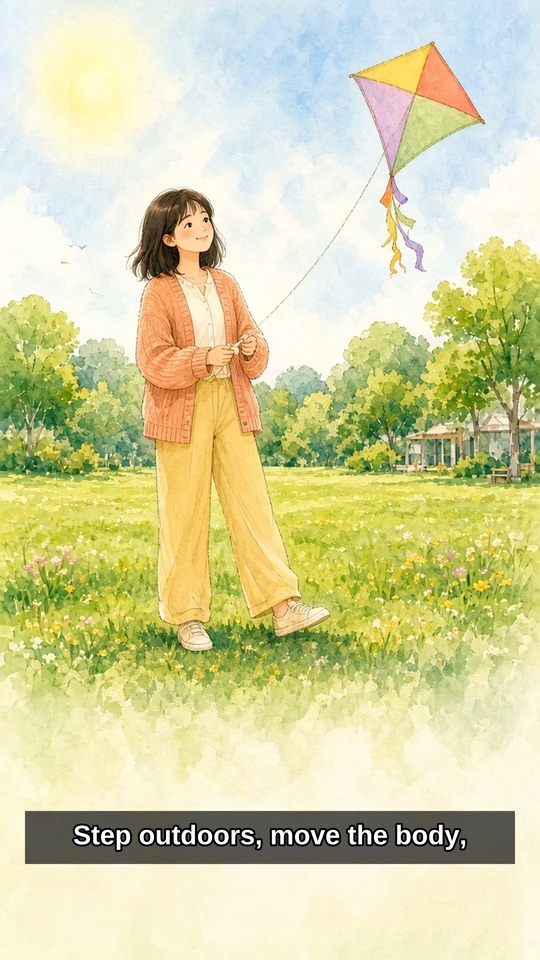
The spring passage describes comfortable outdoor walking and a relaxed body. Kite-flying is our everyday example: move gently, shift your gaze away from the phone and make some room in the day. There is no claim that a seasonal force lifts the kite or that this activity treats liver disease.
Care for mood alongside daily rhythm
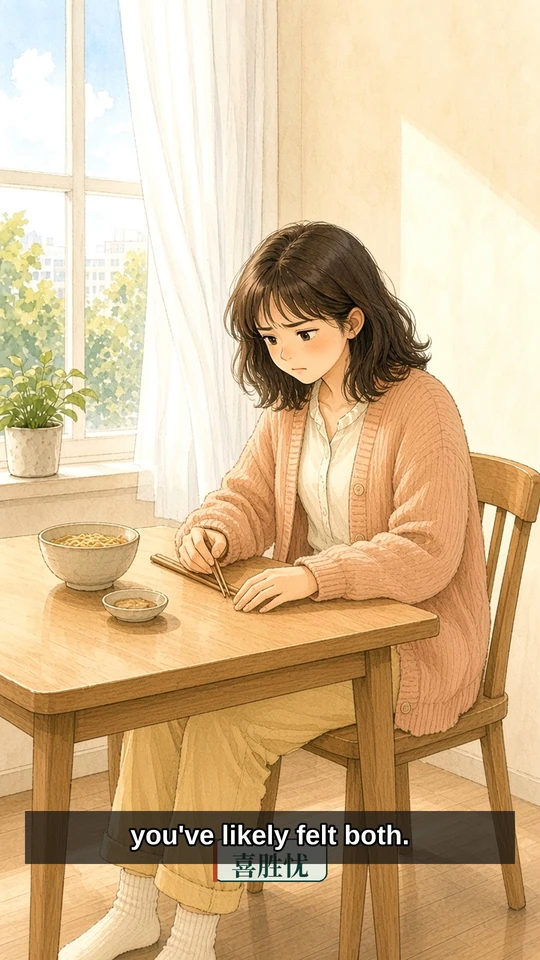
Anger, pressure or worry can coincide with changes in appetite or sleep. NHS guidance describes how stress can affect digestion and appetite; this supports the ordinary connection, without proving the traditional Five Phases map or an emotion-based treatment mechanism. The classical emotion correspondences are a traditional framework, not a way to diagnose organ disease or a direction to induce strong emotions.
Walk with someone who listens
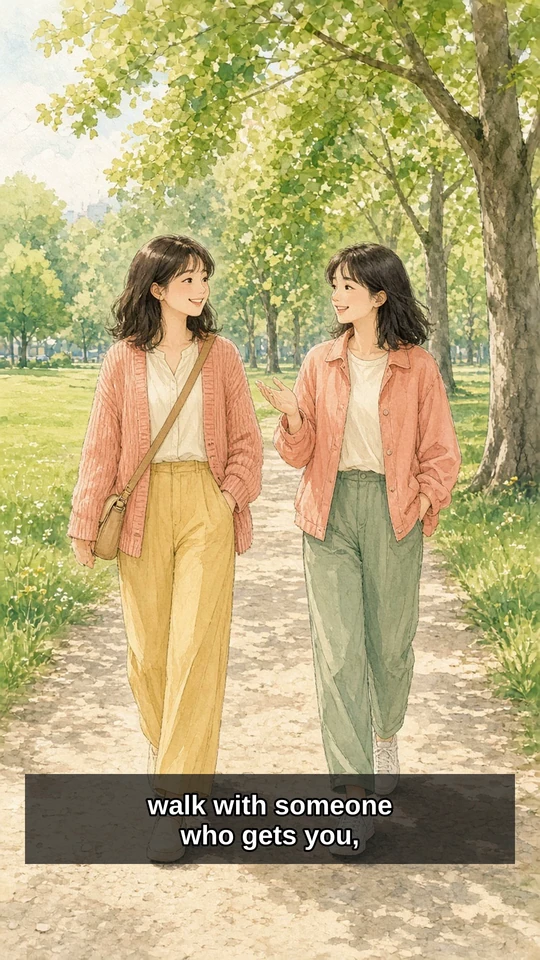
Try one comfortable walk with a person you trust. Talk about what is weighing on you, without having to put on a cheerful face. The change illustrated here is posture, activity and connection; no disease recovery or guaranteed outcome is depicted.
Suwen Chapter 2 (Si Qi Diao Shen Da Lun) supplies the spring passage 广步于庭,被发缓形. Chapter 5 (Yin Yang Ying Xiang Da Lun) supplies traditional organ–emotion correspondences and 喜胜忧. Chapter 29 (Tai Yin Yang Ming Lun) also describes Spleen–Earth nourishing the other systems through all four seasons. Late summer is commonly associated with the hot, humid late part of summer; different traditional accounts allocate Earth differently. These are traditional functional systems, not simply anatomical organs or a symptom-based organ diagnosis. Kite-flying and a friendly walk are present-day daily-care applications, not practices prescribed by these quotations or proof of treatment effects. The English quotations are project editorial renderings.
广步于庭,被发缓形
Editorial translation: Walk freely in the courtyard; let the body relax.
Read the Chinese source · Suwen · Chapter 2 · 四气调神大论 →喜胜忧
Editorial translation: Joy overcomes sorrow.
Read the Chinese source · Suwen · Chapter 5 · 阴阳应象大论 →脾者土也,治中央,常以四时长四藏,各十八日寄治,不得独主于时也。
Editorial translation: Spleen belongs to Earth and occupies the centre, nourishing the other four systems through the seasons, with eighteen days allocated to each; it does not govern a season exclusively.
Read the Chinese source · Suwen · Chapter 29 · 太阴阳明论 →A gentle walk and conversation are everyday coping options, not treatments for organ disease or persistent mental-health symptoms. If changes in appetite, sleep or mood keep disrupting daily life, seek appropriate professional care. Adapt outdoor activity to your comfort, local weather and a safe open space. Avoid prolonged neck extension when flying a kite.
Read the full English transcript
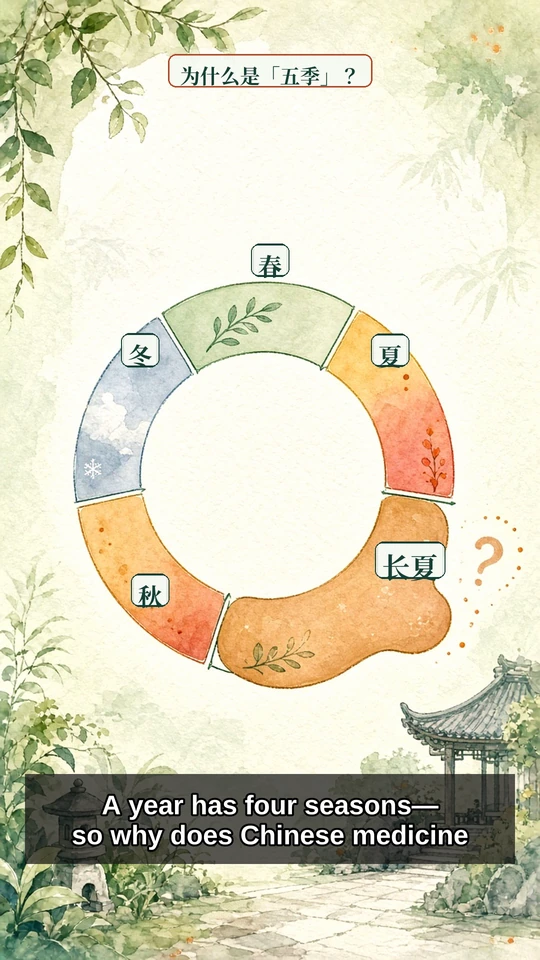
Why five seasons?
A year has four seasons—so why does Chinese medicine speak of five? After the Five Phases: how do they land in daily life?
A traditional map
Spring, summer, late summer, autumn, winter map to Wood, Fire, Earth, Metal, Water— and to Liver, Heart, Spleen, Lung, Kidney in the classical frame. “Late summer” often means those hot, damp days at summer’s end; Earth is also said to run through all four seasons.
Give yourself room
How do these correspondences reach everyday life? Take spring: it belongs to Wood—growth and opening. Don’t stay cooped up all day with the chest held tight.
Step outdoors
Why do some people fly a kite in spring? Step outdoors, move the body, lift the eyes off the phone— and give the mood somewhere else to go. The Neijing says: “Walk broadly in the courtyard; let the hair loose and ease the form.”
Feelings reach everyday life
Care of life also means care of mood. Anger that kills appetite, worry that steals sleep— you’ve likely felt both. The classics link anger, joy, thought, sorrow, and fear with the five zang, and speak of emotions checking one another— for example, “joy overcomes sorrow.”
Walk with someone who gets you
In daily life, start small: walk with someone who gets you, say what’s on your mind, and let the loop of worry take a breath.
Keep reading
Tend the body with the season’s rhythm— and leave the mood a way out. Notes on the Neijing—yineijing.com. Traditional wellness culture to share; not a substitute for medical advice.
中文要点 · Chinese summary
中医将春、夏、长夏、秋、冬与木、火、土、金、水及传统脏腑系统相联系。长夏常指夏末湿热时期,古典理论也有土寄旺四季的说法,不设全球固定日期。春季放风筝是“广步于庭,被发缓形”的现代生活应用,不是经典原文规定的疗法。“喜胜忧”属于情志相胜理论;日常可以从与可信赖的人散步交谈、为情绪留出口开始,不用情绪诊断器官,也不通过惊吓或激怒治病。