Autumn · Chinese solar term
Beginning of Autumn
立秋
Beginning of Autumn (立秋) is one of the six autumn terms in the traditional Chinese solar calendar. Let the weather guide the change
Find this term’s date in the Chinese lunar calendar
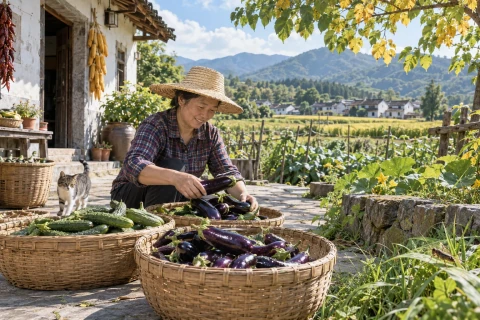
Illustration & cultural context · 图画说明
The story inside the image
Late-summer vegetables and gradual seasonal change
A villager sorts late-summer vegetables while the landscape remains mostly green. Beginning of Autumn is a traditional seasonal marker, not an instant change to cool weather or red leaves. Small hints of change convey a transition.
中文 · 为什么这样画
立秋,先有时令转换,未必满山红叶
村民整理茄子等夏末蔬菜,环境仍有大量绿色,只添少量转色叶。立秋标志传统秋季起点,不代表天气立刻转凉或树叶全变黄。此图用夏末收获与细微变化表现过渡,不强画深秋景象。
An editorial interpretation of regional farming, traditional phenology, or local custom. This is a generated illustration, not a documentary photograph or a forecast for every place.
Educational guidance for adults, not a diagnosis or a substitute for clinical assessment.
Bring the idea into your day
Let the weather guide the change
The calendar has reached autumn; your afternoon may still be hot. Start by checking what has actually changed around you.
- Before going out. Check the forecast for your journey. Keep the cooler route or indoor option you used during hot weather if it is still needed.
- At your next meal. Keep a familiar staple, vegetables and suitable protein on the menu. Choose a comfortable serving temperature for today’s weather.
- Tonight. Choose one task to finish before your quiet evening interval; leave the next day’s less urgent task for tomorrow.
How this term differs, review & sources
This point in the season. Beginning of Autumn is a check of actual conditions. End of Heat next turns to whether the weather allows a gradual return to outdoor activity.
Review after a week. Which change followed the actual weather, and which part of your evening was easy enough to repeat? A week is a convenient time to review what fits your life.
Traditional reading · Suwen · Chapter 2 · 四气调神大论篇第二
早卧早起,与鸡俱兴。使志安宁。
Editorial translation. Retire early and rise early, rising with the chickens; keep intention peaceful.
The autumn passage connects daily rhythm with settling the spirit. Its historical daylight references are read alongside present work, family life and local conditions.
Application today. These practical suggestions, meal examples and environment choices are contemporary editorial applications of this seasonal framework.
Read the seasonal source context →Modern sources and their scope. Meal combinations, clothing arrangements and term-by-term emphasis are editorial examples.
- UK Health Security Agency · Beat the heat. Checking forecasts, choosing cooler activity settings and planning access to drinks.
- NHS · The Eatwell Guide. Varied food groups across the day or week; individual dietary needs still apply.
- NHS · Insomnia. Regular waking, a quiet transition and a comfortable sleep setting.
Sources checked 2026-10-09. Match meals, fluids and activity to any existing care plan.
The Chinese calendar marks this term worldwide. Your local season and care priorities may differ. Your selection stays on this page.
Read the wider autumn-care framework
Daily seasonal care · 秋 · 收
Gather a steady rhythm; care for moistening
Classical reasoning. The autumn passage joins earlier retiring with keeping intention peaceful and gathering the spirit. The traditional Lung–metal association adds attention to breathing and moistening as conditions become drier.
Sleep & rhythm
Make evenings more consistent as schedules change. Arrange adequate sleep around work and caregiving, with fewer unnecessary late demands.
Movement & recovery
Keep familiar moderate activity, adapt clothing to changing temperatures, and allow a gradual beginning and ending.
Food & fluids
Keep meals varied and fluids regular. Familiar soups, cooked vegetables and fruit can provide comfortable food choices in dry conditions.
Mind & emotions
Reduce one unnecessary commitment while keeping supportive contact. Gathering can mean directing attention toward fewer worthwhile things.
Present-day applications of the seasonal framework. Match them to actual conditions, your daily needs and any existing care plan.
Read the complete seasonal guide →01 · Nature & astronomy
A turning point in the year.
This term corresponds to an apparent solar ecliptic longitude of 135°. It is one of the six traditional terms associated with autumn. The illustration explores a seasonal cultural scene; it does not determine the astronomical date. Calendar day labels are available for 1901–2099 in UTC+8; exact local transition times are not displayed.
02 · Classical reading
Begin with the season.
秋三月,此谓容平。
Editorial translation: “The three months of autumn are called gathering and balance.”
This is a passage about the broader season, not a prescription specific to Beginning of Autumn. Read our short four-season guide for the main ideas, and adapt daily care to your actual conditions.
Read the seasonal source cardThe reasoning behind a choice.
Feeling unwell? Find the right kind of help →
Connect this season with yang qi, dampness and digestion, yin and fluids, food, and tool suitability. Use the season as context, then choose a care direction that fits your current experiences and routine.