Winter · Chinese solar term
Major Cold
大寒
Major Cold (大寒) is one of the six winter terms in the traditional Chinese solar calendar. Keep what worked and adjust one next step
Find this term’s date in the Chinese lunar calendar
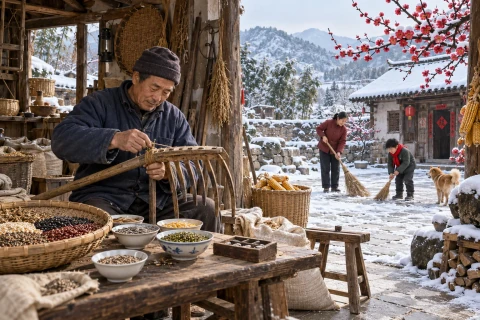
Illustration & cultural context · 图画说明
The story inside the image
Winter preparation and approaching New Year culture
Repairing tools, sorting saved seeds, and sweeping a courtyard connect winter preparation with the next farming cycle and approaching New Year traditions. Major Cold closes the solar-term cycle; it is not a fixed Lunar New Year date or a universal temperature minimum.
中文 · 为什么这样画
大寒,冬藏也包含为下一轮春耕准备
修理农具、整理种子与家人扫院,把一年将尽的农闲安排和迎岁文化联系起来。大寒是二十四节气循环的末端,但不是每年同一天过春节,也不能说全国全年最低温一定出现在大寒。雪与梅花是地域性冬景组合。
An editorial interpretation of regional farming, traditional phenology, or local custom. This is a generated illustration, not a documentary photograph or a forecast for every place.
Educational guidance for adults, not a diagnosis or a substitute for clinical assessment.
Bring the idea into your day
Keep what worked and adjust one next step
Review the routine you actually managed: a meal, a sleep arrangement or an activity. Use local conditions to decide what to carry forward.
- Name one useful habit. Choose a preparation that made a difficult day easier and decide where it belongs in next week’s plan.
- Check the food plan. Keep one easy varied meal in rotation and replace an ingredient that was hard to find or prepare.
- Choose one adjustment. If your familiar activity is comfortable during and afterward, consider a small gradual change; otherwise keep it manageable and review what made it difficult.
How this term differs, review & sources
This point in the season. Minor Cold reviewed one activity from start to finish. Major Cold selects useful habits to retain; Beginning of Spring then considers a gradual return to activity as local conditions allow.
Review after a week. Which habit was worth keeping? Was the single adjustment manageable during the day and afterward? A week is a convenient time to review what fits your life.
Traditional reading · Suwen · Chapter 2 · 四气调神大论篇第二
冬三月,此谓闭藏。……早卧晚起,必待日光。……去寒就温,无泄皮肤,使气亟夺。
Editorial translation. The three months of winter are called closing and storing. … Retire early and rise later, waiting for daylight. … Avoid cold and seek warmth; do not let the skin release so that qi is rapidly depleted.
These excerpts describe winter storage, rest and protection from cold in the classical seasonal setting. The last clause is traditionally read as caution about excessive sweating and depletion. Daylight, work and weather differ across regions; the passage does not set a universal modern waking time.
Application today. These practical suggestions are present-day editorial applications: make recovery workable, retain manageable activity and use ordinary varied meals. Winter storage does not require avoiding exercise, suppressing normal sweating or eating extra-rich food. Choose warmth or cooling for your actual conditions.
Read the seasonal source context →Modern sources and their scope. Meal combinations, clothing arrangements and term-by-term emphasis are editorial examples.
- NHS · Walking for health. Familiar routes and gradual increases after inactivity, where walking is suitable.
- NHS · The Eatwell Guide. Variety across ordinary food groups, including frozen and cupboard ingredients.
- NHS · How to be more active. Small activity opportunities and breaks from long periods of sitting.
Sources checked 2026-10-10. Match meals, fluids and activity to any existing care plan.
The Chinese calendar marks this term worldwide. Your local season and care priorities may differ. Your selection stays on this page.
Read the wider winter-care framework
Daily seasonal care · 冬 · 藏
Conserve recovery; keep warmth and gentle movement
Classical reasoning. Winter emphasises earlier retiring, warmth and conserving. Within autumn–winter nourishment of yin, the passage also asks that yang be protected: recovery and comfortable warmth work together.
Sleep & rhythm
Protect a regular sleep opportunity. If work fixes your waking time, organise bedtime around that need and allow a gentler start when possible.
Movement & recovery
Warm up gradually, choose a suitable surface and setting, and keep manageable movement through the week. Adjust the workload to your recovery.
Food & fluids
Warm cooked meals can be comfortable in cold conditions. Keep variety, a suitable protein source and measured portions alongside that warmth.
Mind & emotions
Leave time for quiet recovery and maintain contact with people who support you. Make a quieter routine sustainable rather than isolated.
Present-day applications of the seasonal framework. Match them to actual conditions, your daily needs and any existing care plan.
Read the complete seasonal guide →01 · Nature & astronomy
A turning point in the year.
This term corresponds to an apparent solar ecliptic longitude of 300°. It is one of the six traditional terms associated with winter. The illustration explores a seasonal cultural scene; it does not determine the astronomical date. Calendar day labels are available for 1901–2099 in UTC+8; exact local transition times are not displayed.
02 · Classical reading
Begin with the season.
冬三月,此谓闭藏。
Editorial translation: “The three months of winter are called closing and storing.”
This is a passage about the broader season, not a prescription specific to Major Cold. Read our short four-season guide for the main ideas, and adapt daily care to your actual conditions.
Read the seasonal source cardThe reasoning behind a choice.
Feeling unwell? Find the right kind of help →
Connect this season with yang qi, dampness and digestion, yin and fluids, food, and tool suitability. Use the season as context, then choose a care direction that fits your current experiences and routine.