Winter Solstice · 冬至 · Dongzhi
Winter Solstice:
Dark before your day is done?
In the traditional Chinese solar calendar, Winter Solstice 2026 falls on (UTC+8). You leave in the dark and finish work in the dark. Where winter days are short, it can feel as though daylight has happened without you. A lunch break may be the part of the day you can reclaim.
Solar-term period: Dec 22, 2026 – Jan 4, 2027. Check another year in the calendar →
Find a daylight break that actually fits. Look at tomorrow’s schedule and local forecast. If possible, use a break for a familiar short outdoor route in safe conditions. If that does not fit your work, mobility or weather, change setting indoors instead; keep your sleep routine workable.
Choose a comfortable option for your circumstances. Adapt the guidance to your local conditions ↓
Find this term’s date in the Chinese lunar calendar
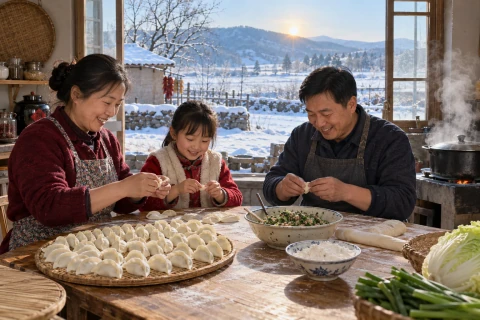
Illustration & cultural context · 图画说明
The story inside the image
Northern regional custom; December solstice
A low winter sun outside and a family shaping dumplings connect the solstice with home life. The December solstice brings the shortest daylight period in the Northern Hemisphere. Dumplings are a northern regional custom; other communities have different foods and traditions.
中文 · 为什么这样画
冬至,最短日照与北方团聚食俗
窗外低日光和冬景,屋内一起包饺子,把天文转折与家庭生活相连。冬至是北半球白昼通常最短的时段,过后白昼逐渐增长;包饺子属于中国部分北方地区的习俗,南方等地另有汤圆等传统。
An editorial interpretation of regional farming, traditional phenology, or local custom. This is a generated illustration, not a documentary photograph or a forecast for every place.
The period above runs from the term’s UTC+8 civil date through the day before the next term. It does not show the exact astronomical transition time.
Is Dongzhi the shortest day everywhere?
Dongzhi (冬至) is the December solstice, a turning point in the Sun’s annual cycle. It brings the shortest daylight period of the year in the Northern Hemisphere and the longest in the Southern Hemisphere; the change is smaller near the equator. Its local calendar date depends on time zone. The date above uses UTC+8.
What does the Neijing add?
Suwen, Chapter 2, describes winter as closing and storing and includes the line “早卧晚起,必待日光” about resting early and waiting for daylight. This is a classical seasonal account, not a universal alarm-clock setting. Work, care duties and local light still matter. The break suggested here is our modern application.
Read the winter passage in Suwen, Chapter 2 →
Calendar references: Hong Kong Observatory · 2026 dates · 2027 dates for the next term · Solar-term names and astronomy.
Educational guidance for adults, not a diagnosis or a substitute for clinical assessment.
Bring the idea into your day
Arrange the day around your local light
This December marker falls near the shortest day in the Northern Hemisphere and the longest in the Southern Hemisphere. Tropical daylight changes less; your own timetable still matters.
- Check your available interval. Look at local daylight and the forecast, then choose a practical time for a short outdoor errand or familiar activity.
- Keep a sleep anchor. Use a waking time that fits your responsibilities and protect enough sleep opportunity around it; daylight need not set your alarm.
- Plan a point of contact. Arrange a meal, call or visit at a time that works for you and someone whose company you welcome.
How this term differs, review & sources
This point in the season. Major Snow prepared for interrupted plans. Winter Solstice considers local light, daily rhythm and contact; Minor Cold next follows one activity from preparation through recovery.
Review after a week. Did the chosen activity time fit daylight, weather and your responsibilities? Was the sleep anchor workable? A week is a convenient time to review what fits your life.
Traditional reading · Suwen · Chapter 2 · 四气调神大论篇第二
冬三月,此谓闭藏。……早卧晚起,必待日光。……去寒就温,无泄皮肤,使气亟夺。
Editorial translation. The three months of winter are called closing and storing. … Retire early and rise later, waiting for daylight. … Avoid cold and seek warmth; do not let the skin release so that qi is rapidly depleted.
These excerpts describe winter storage, rest and protection from cold in the classical seasonal setting. The last clause is traditionally read as caution about excessive sweating and depletion. Daylight, work and weather differ across regions; the passage does not set a universal modern waking time.
Application today. These practical suggestions are present-day editorial applications: make recovery workable, retain manageable activity and use ordinary varied meals. Winter storage does not require avoiding exercise, suppressing normal sweating or eating extra-rich food. Choose warmth or cooling for your actual conditions.
Read the seasonal source context →Modern sources and their scope. Meal combinations, clothing arrangements and term-by-term emphasis are editorial examples.
- NASA · December Solstice Brings Winter, Summer Seasons. Opposite daylight and seasonal patterns in the Northern and Southern Hemispheres.
- NHS · Insomnia. Regular waking, a quieter transition and a comfortable sleep setting.
- NHS · Walking for health. Familiar routes and gradual increases after inactivity, where walking is suitable.
- NHS · Every Mind Matters · Loneliness. Keeping in touch and choosing accessible shared activities or conversation.
- UK Health Security Agency · Beat the heat. Forecast checks, cooler activity settings, access to water and keeping rooms cool.
Sources checked 2026-10-10. Match meals, fluids and activity to any existing care plan.
The Chinese calendar marks this term worldwide. Your local season and care priorities may differ. Your selection stays on this page.
Read the wider winter-care framework
Daily seasonal care · 冬 · 藏
Conserve recovery; keep warmth and gentle movement
Classical reasoning. Winter emphasises earlier retiring, warmth and conserving. Within autumn–winter nourishment of yin, the passage also asks that yang be protected: recovery and comfortable warmth work together.
Sleep & rhythm
Protect a regular sleep opportunity. If work fixes your waking time, organise bedtime around that need and allow a gentler start when possible.
Movement & recovery
Warm up gradually, choose a suitable surface and setting, and keep manageable movement through the week. Adjust the workload to your recovery.
Food & fluids
Warm cooked meals can be comfortable in cold conditions. Keep variety, a suitable protein source and measured portions alongside that warmth.
Mind & emotions
Leave time for quiet recovery and maintain contact with people who support you. Make a quieter routine sustainable rather than isolated.
Present-day applications of the seasonal framework. Match them to actual conditions, your daily needs and any existing care plan.
Read the complete seasonal guide →01 · Nature & astronomy
A turning point in the year.
This term corresponds to an apparent solar ecliptic longitude of 270°. It is one of the six traditional terms associated with winter. The illustration explores a seasonal cultural scene; it does not determine the astronomical date. Calendar day labels are available for 1901–2099 in UTC+8; exact local transition times are not displayed.
02 · Classical reading
Begin with the season.
冬三月,此谓闭藏。
Editorial translation: “The three months of winter are called closing and storing.”
This is a passage about the broader season, not a prescription specific to Winter Solstice. Read our short four-season guide for the main ideas, and adapt daily care to your actual conditions.
Read the seasonal source cardThe reasoning behind a choice.
Feeling unwell? Find the right kind of help →
Connect this season with yang qi, dampness and digestion, yin and fluids, food, and tool suitability. Use the season as context, then choose a care direction that fits your current experiences and routine.