Summer · Chinese solar term
Grain in Ear
芒种
Grain in Ear (芒种) is one of the six summer terms in the traditional Chinese solar calendar. Put a break inside the demanding part of the day
Find this term’s date in the Chinese lunar calendar
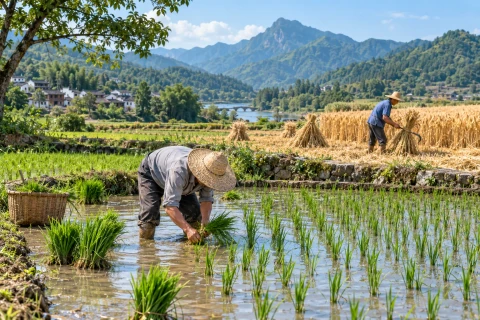
Illustration & cultural context · 图画说明
The story inside the image
Composite regional farming narrative
Rice transplanting and wheat harvesting illustrate the busy transition between crops. Golden wheat belongs on dry land; young rice seedlings belong in the flooded paddy. The composition brings regional practices together without claiming a universal schedule or identical field conditions.
中文 · 为什么这样画
芒种,麦收与插秧两头忙
前景插秧、后景麦收,把“有芒作物”的收种农忙讲清楚:金黄的是成熟小麦,水里的是新栽稻苗。画面是农事主题的组合表达,不宣称全国、或同一块田在这一天同时完成这些工作。
An editorial interpretation of regional farming, traditional phenology, or local custom. This is a generated illustration, not a documentary photograph or a forecast for every place.
Educational guidance for adults, not a diagnosis or a substitute for clinical assessment.
Bring the idea into your day
Put a break inside the demanding part of the day
Work, care duties and travel can leave recovery until everything is finished. Identify the longest demanding stretch and change its structure.
- Name the pressure point. Pick the task or journey that leaves no pause and decide which optional part can move.
- Agree practical cover. If someone depends on you, arrange who can cover a short break; at work, raise heat and break needs with the supervisor.
- Make the pause usable. Choose a comfortable place and keep drinking water accessible. In heat, reduce demanding effort and use a cooler recovery area.
How this term differs, review & sources
This point in the season. Grain Buds protected lunch. Grain in Ear changes the demands around it; Summer Solstice next protects sleep amid local daylight and evening commitments.
Review after a week. Was the break possible during the hardest stretch? Did the workload need changing as well as the timetable? A week is a convenient time to review what fits your life.
Traditional reading · Suwen · Chapter 2 · 四气调神大论篇第二
夏三月,此谓蕃秀。……使志无怒,使华英成秀,使气得泄,若所爱在外。
Editorial translation. The three months of summer are called flourishing. … Keep intention free of anger; let flowering come to fullness; allow qi to find expression, as though what one loves were outside.
The passage describes summer growth and outward expression. Its surrounding lines also describe late retiring, early rising and not disliking the sun within the classical seasonal setting. These are historical ideas, not a modern sleep duration or heat-exposure rule.
Application today. These practical suggestions are present-day editorial applications: prepare for local conditions, keep meals workable and give activity enough recovery. Outward expression does not require forced sweating, emotional suppression or enduring heat. Protect sufficient sleep and use modern heat and sun precautions. Southern Hemisphere winter and tropical conditions need their own choices.
Read the seasonal source context →Modern sources and their scope. Meal combinations, clothing arrangements and term-by-term emphasis are editorial examples.
- CDC / NIOSH · Workplace Recommendations. Reducing demanding work in heat, recovery in a cool area and employer-supported access to breaks and water.
- NHS · Water, drinks and hydration. Regular drinking opportunities and fluid needs that vary with circumstances.
Sources checked 2026-10-10. Match meals, fluids and activity to any existing care plan.
The Chinese calendar marks this term worldwide. Your local season and care priorities may differ. Your selection stays on this page.
Read the wider summer-care framework
Daily seasonal care · 夏 · 长
Support flourishing; protect fluids and rest
Classical reasoning. The summer passage describes flourishing and keeping intention free of anger. In daily care, outward activity belongs with the fluids, nourishment and recovery that sustain it.
Sleep & rhythm
Protect your main sleep opportunity even during long evenings. Keep the room comfortable and make the transition toward bedtime quieter.
Movement & recovery
Choose cooler hours or shade in hot weather, use a manageable intensity, and take cooling breaks. Stop activity if heat makes you dizzy or unwell.
Food & fluids
Use regular, varied meals and have water available within any prescribed fluid plan. Familiar lighter preparations can make eating easier in hot conditions.
Mind & emotions
Enjoy company at a pace that suits you. Give a full day quiet intervals so that sociability and rest can coexist.
Present-day applications of the seasonal framework. Match them to actual conditions, your daily needs and any existing care plan.
Read the complete seasonal guide →01 · Nature & astronomy
A turning point in the year.
This term corresponds to an apparent solar ecliptic longitude of 75°. It is one of the six traditional terms associated with summer. The illustration explores a seasonal cultural scene; it does not determine the astronomical date. Calendar day labels are available for 1901–2099 in UTC+8; exact local transition times are not displayed.
02 · Classical reading
Begin with the season.
夏三月,此谓蕃秀。
Editorial translation: “The three months of summer are called flourishing and abundance.”
This is a passage about the broader season, not a prescription specific to Grain in Ear. Read our short four-season guide for the main ideas, and adapt daily care to your actual conditions.
Read the seasonal source cardThe reasoning behind a choice.
Feeling unwell? Find the right kind of help →
Connect this season with yang qi, dampness and digestion, yin and fluids, food, and tool suitability. Use the season as context, then choose a care direction that fits your current experiences and routine.