Summer · Solar term
Summer Solstice
夏至
A long day still needs rest
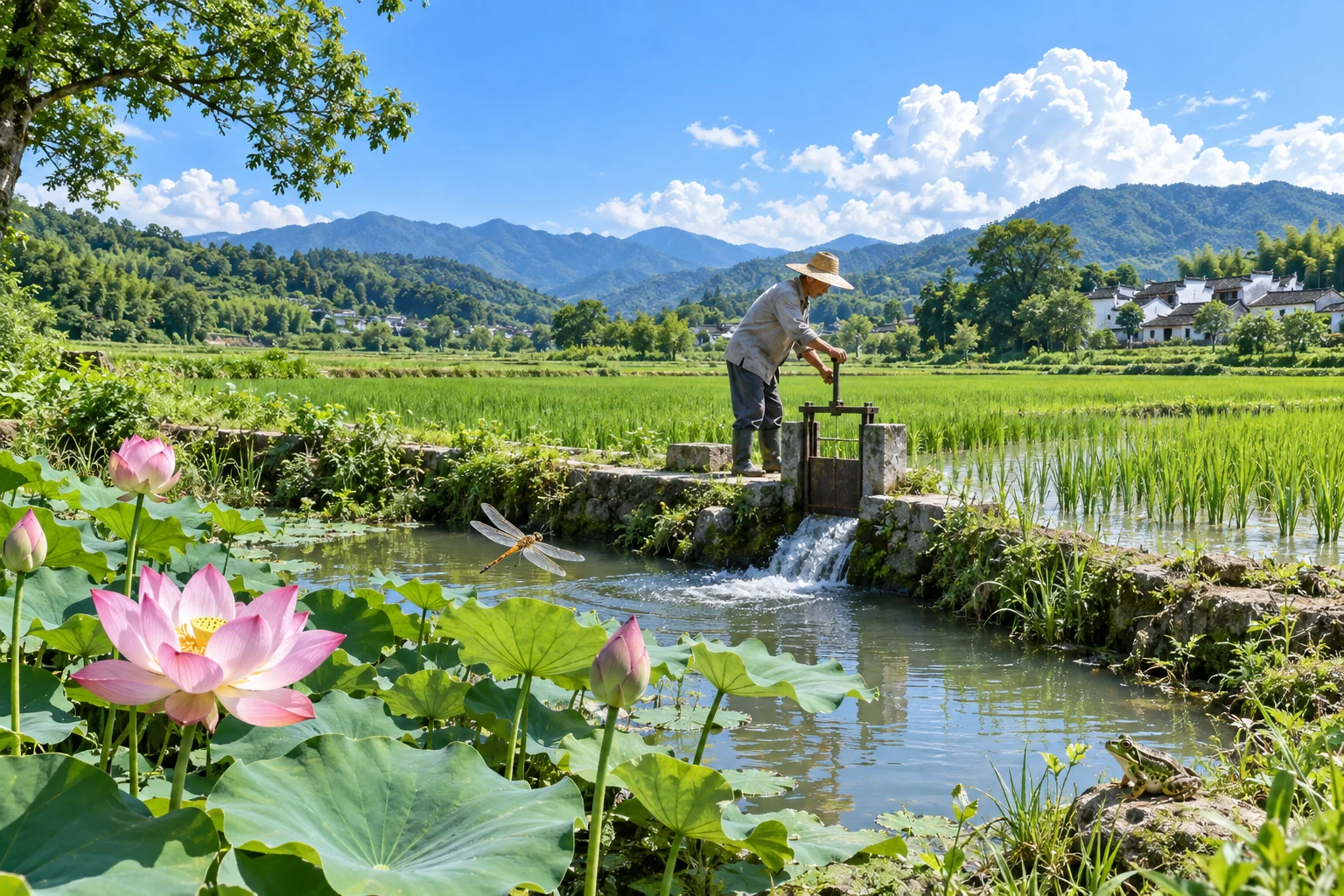
Illustration & cultural context · 图画说明
The story inside the image
Northern Hemisphere June solstice; summer fieldwork
An irrigation channel, growing rice, and lotus connect long summer days with water management. The June solstice brings the longest daylight period in the Northern Hemisphere; it is not necessarily the hottest day. The field remains in its growing stage.
中文 · 为什么这样画
夏至,长日照里的田间用水
灌溉沟渠、绿色稻田与荷塘表现盛夏生长所需的水分。夏至的核心是北半球一年中白昼通常最长的时段,而不是一年中气温必然最高;田间用水与荷花是季节生活场景,作物仍以生长为主。
An editorial interpretation of regional farming, traditional phenology, or local custom. This is a generated illustration, not a documentary photograph or a forecast for every place.
Daily seasonal care · 夏 · 长
Allow activity while protecting rest and fluids
This term’s practical focus · Editorial application
A long day still needs rest
Protect a consistent sleep schedule despite long daylight where you live. Use cooler hours or an appropriate indoor setting for activity in heat; avoid accumulating sleep debt.
Classical reasoning. The summer chapter describes flourishing, emotional openness, and activity within a longer day. The spring–summer emphasis on nourishing yang does not mean deliberately overheating the body.
Sleep & rhythm
Maintain sufficient sleep even when daylight lasts longer. Keep the sleeping space comfortable and avoid using late evenings to accumulate sleep debt.
Movement & recovery
In hot weather, choose cooler hours or a suitable indoor space, reduce intensity when necessary, and pause rather than push through heat-related dizziness.
Food & fluids
Keep meals regular and varied, and have drinking water available. Follow any prescribed fluid restriction; do not replace meals with juices or herbal drinks.
Mind & emotions
Enjoy company if it suits you, with quiet intervals. A busy social calendar is optional, not an obligation to match the season.
Contemporary daily-care applications, not a prescription unique to this solar term. Adjust to actual conditions and any existing care plan.
Read the complete seasonal guide →01 · Nature & astronomy
A turning point in the year.
This term corresponds to an apparent solar ecliptic longitude of 90°. It is one of the six traditional terms associated with summer. The illustration explores a seasonal cultural scene; it does not determine the astronomical date. Calendar day labels are available for 1901–2099 in UTC+8; exact local transition times are not displayed.
02 · Classical reading
Begin with the season.
夏三月,此谓蕃秀。
Editorial translation: “The three months of summer are called flourishing and abundance.”
This is a passage about the broader season, not a prescription specific to Summer Solstice. Read our short four-season guide for the main ideas, and adapt daily care to your actual conditions.
Read the seasonal source cardThe reasoning behind a choice.
Feeling unwell? Find the right kind of help →
Connect this season with yang qi, dampness and digestion, food, and tool suitability. A calendar label alone does not establish a pattern or justify a treatment.