Spring · Solar term
Awakening of Insects
惊蛰
Build activity, not intensity
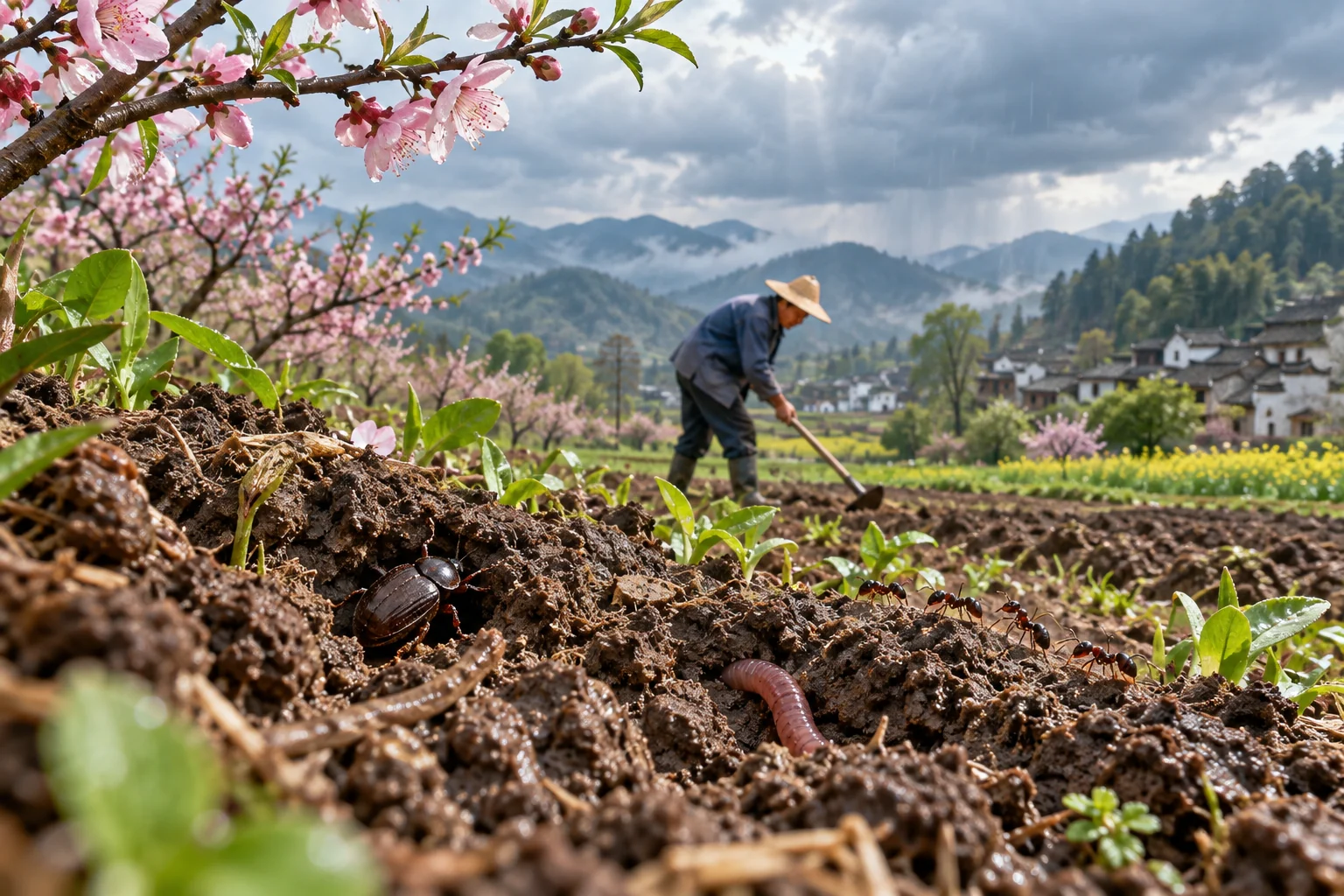
Illustration & cultural context · 图画说明
The story inside the image
Traditional phenology interpreted through soil life
Beetles, ants, and an earthworm connect soil life with spring fieldwork; blossom recalls traditional phenology. The thunder imagery is cultural. Renewed activity depends on environmental conditions, rather than thunder waking every creature. The earthworm is a soil animal, not an insect.
中文 · 为什么这样画
回暖后,土壤里的生命重新活动
近景甲虫、蚂蚁和蚯蚓与远处松土农人构成从土壤到春耕的联系,桃花呼应传统物候。惊蛰的雷声意象属于文化表达;虫类活动主要与温度等环境条件变化有关,不能解释为雷声直接把所有虫子叫醒,蚯蚓也不是昆虫。
An editorial interpretation of regional farming, traditional phenology, or local custom. This is a generated illustration, not a documentary photograph or a forecast for every place.
Daily seasonal care · 春 · 生
Support emergence without exhausting yourself
This term’s practical focus · Editorial application
Build activity, not intensity
Use a regular walking or mobility interval to resume activity if conditions allow. Increase gradually; do not treat soreness or heavy sweating as proof that yang has risen.
Classical reasoning. The spring chapter connects emerging life with rising early, unhurried walking, and a generous rather than punitive disposition. Its instruction to retire later belongs to a historical seasonal framework; it is not a reason to shorten needed sleep.
Sleep & rhythm
Keep a dependable waking time and enough sleep. If earlier mornings suit your day, move bedtime with them rather than cutting rest.
Movement & recovery
Resume familiar walking or mobility gradually after an inactive period. Begin below your old training level and leave room for recovery.
Food & fluids
Keep regular, varied meals: a familiar grain or staple, vegetables, and a protein source. Spring does not require a sour-food cure, a fast, or a cleanse.
Mind & emotions
Give one manageable task a beginning. Make room for conversation and gentle activity rather than turning renewal into pressure.
Contemporary daily-care applications, not a prescription unique to this solar term. Adjust to actual conditions and any existing care plan.
Read the complete seasonal guide →01 · Nature & astronomy
A turning point in the year.
This term corresponds to an apparent solar ecliptic longitude of 345°. It is one of the six traditional terms associated with spring. The illustration explores a seasonal cultural scene; it does not determine the astronomical date. Calendar day labels are available for 1901–2099 in UTC+8; exact local transition times are not displayed.
02 · Classical reading
Begin with the season.
春三月,此谓发陈。
Editorial translation: “The three months of spring are called the opening of the new.”
This is a passage about the broader season, not a prescription specific to Awakening of Insects. Read our short four-season guide for the main ideas, and adapt daily care to your actual conditions.
Read the seasonal source cardThe reasoning behind a choice.
Feeling unwell? Find the right kind of help →
Connect this season with yang qi, dampness and digestion, food, and tool suitability. A calendar label alone does not establish a pattern or justify a treatment.